

FIBERWOOD 25 "
Fiberwood 25” riser in stratified and resin-coated wood with cradles, designed for recurve bow, instinctive bow and barebow.
The structure in crossed and resin-coated stratified wood guarantees maximum stiffness and resistance to stress.
It is equipped with ILF compatible adjustable cradles.
Designed for double fixing rest and usable with arrow rest.
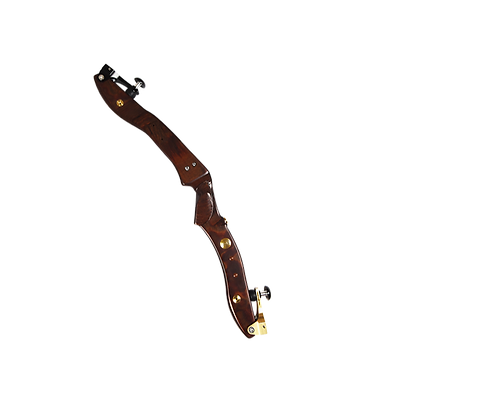


FIBERWOOD 25"
Fiberwood 25” riser is a cross-laminated and resin-coated wooden bow that guarantees maximum stiffness and resistance to stress. Usable for multiple disciplines: recurve bow, instinctive bow and barebow.
From the neophyte who wants to embark on a performing path, to the agonist who seeks the extra point compared to his previous training session.
The total weight of the riser is approximately 1300 grams: this is the sum of the weights of the central structure, the two cradles and the various assembled components. Additional information regarding standard supplied cradles: upper cradle in aluminum (weight approx. 55 g.); lower cradle in brass (weight approx. 170 g.). The adjustable cradles can allow considerable variations in poundage of approx. 8% with respect to the nominal poundage of the limb.
The dowel inside the cradle also allows you to correct any misalignments related to the limbs by adjusting the alignment plate in an optimal way: in this way, you can correct the aiming point based on the personal "sight" of the aiming line. The presence of the through holes (d.6 mm) in the lower part allows for the addition of weights to adjust the center of gravity based on one's own style of shooting and pressure on the grip.

WA rules instinctive shooting rules valid until 2022 now obsolete
REFERENCE
Interpretations Rules and constitutions of world archery
Book 4, Chapter 22, Article 22.4.1
The question of what constitutes an appropriate limb locking system for the second limb on the bows used in the Instinctive Shooting Division is a subjective one.
"Article 22.4.1 states that the bow cannot have adjustable cradles. However, as long as a cradle is locked and cannot be adjusted during competition, the Technical Committee believes this is an adequate solution for instinctive shooting. "
The concept is to place a metal or hard plastic spacer / washer between the riser and the limb adjustment screw flange / stop.
The limb would then be loosened on top of the spacer as far as possible, so that it is hard enough not to be adjustable. If during the competition a judge notices some space between the spacer and the riser or flange, then they will know that the screw has been tampered with.
Otherwise, the athlete could tighten the screw to the maximum, without any spacing, so that it cannot be adjusted later. The athlete can demonstrate, at the request of the judge, that the screw cannot be tightened further on the spacer.
Using this method of attaching a limb, the bow is not damaged, and works as a single, solid, non-adjustable limb.
Note: Spacers must be made of a rigid material that cannot be compressed by fully tightening the limb adjustment screw. Judges can test the spacers with the tip of a pin to be sure there is no rubber or other compressible material.